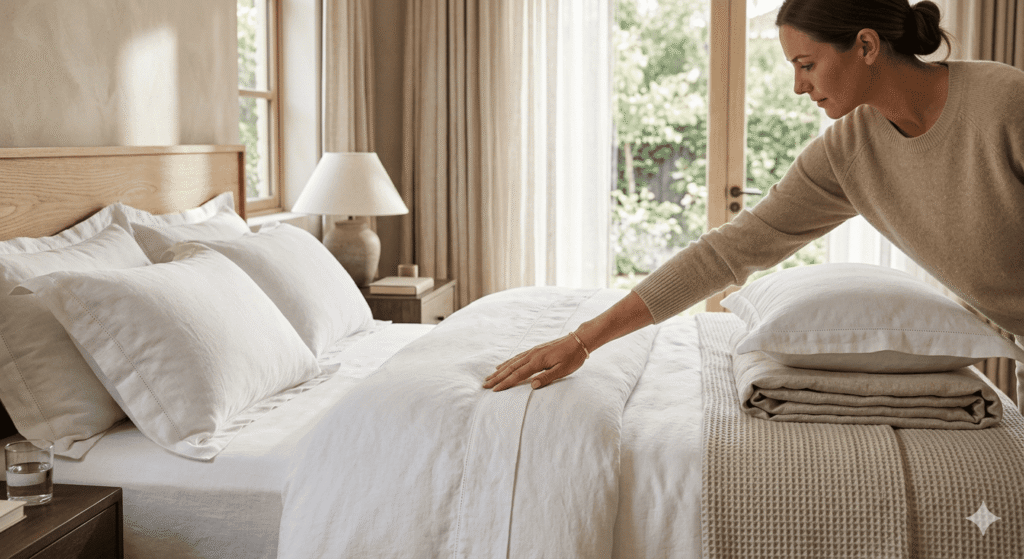
Most people will spend thousands on a good mattress but barely think twice about the bedding that goes on top of it. Here’s the thing , your bedding set does just as much work. The right bed sheets, duvet cover, and pillowcases can genuinely change how well you sleep. This guide breaks down everything that matters: fabric, weave, fit, and how to build a sleep environment that actually supports real rest.
Why Your Bedding Set Matters More Than You Think
The Link Between Sleep Comfort and Sleep Quality
There’s a reason hotel beds feel so good. It’s not just the mattress, it’s the whole package. The sleep environment you create in your own bedroom has a direct impact on how easily you fall asleep and how deeply you stay there through the night.
Sleep comfort is cumulative. The weight of your duvet, the feel of your sheets against your skin, even the visual calm of a well-made bed, all of it signals to your brain that it’s time to wind down. When your bedding is scratchy, too heavy, or just not right for your body, that signal gets disrupted. You toss, you adjust, you wake up at 2am throwing the covers off.
Getting your bedding right isn’t a luxury. It’s one of the more practical investments you can make in your own sleep quality.
How Bedding Affects Body Temperature Overnight
Your body naturally drops in temperature as you move into deeper sleep. Bedding that traps heat or doesn’t breathe well works against that process and that’s usually what’s behind the midnight overheating that jolts people awake.
Breathability and moisture-wicking are the two properties worth paying attention to here. Breathable fabrics allow air to circulate so heat doesn’t build up. Moisture-wicking fabrics pull sweat away from the body instead of letting it sit against your skin. Together, they support the kind of temperature regulation your body is already trying to do on its own.
If you’ve ever woken up damp and overheated for no obvious reason, your bed sheets are likely the place to start looking.
Understanding Bedding Fabrics – Which Material Is Right for You?
Not all fabrics feel or perform the same. The right choice depends on how you sleep, where you live, and what comfort means to you personally.
Cotton The Gold Standard for Sleep
Cotton is the most widely used bedding fabric for good reason, it’s breathable, durable, and comfortable across a wide range of climates. But within cotton, there’s a meaningful spectrum.
At the higher end, you have long-staple cotton and Egyptian cotton. Longer fibers produce a smoother, stronger yarn, which translates to sheets that feel softer and hold up better wash after wash. Organic cotton takes that a step further by eliminating the pesticide residue that can linger in conventional cotton worth considering if you have sensitive skin.
Within cotton, the two main options you’ll encounter are cotton percale and cotton sateen. Percale is a one-over-one-under weave that produces a crisp, cool, matte finish great for warm sleepers. Cotton sateen uses a four-over-one-under weave, giving it that smooth, slightly silky feel and a subtle sheen. Both are natural fibers; it really comes down to personal preference and how you regulate temperature.
Fiber quality matters more than most people realize. A well-constructed sheet made from quality natural fibers will outperform a high thread count sheet made from short, weak fibers every single time.
Linen Bedding – Best for Warm Sleepers
Linen bedding has had a real moment over the past few years, and for good reason. It’s one of the most breathable fabrics available , significantly more so than most cotton, which makes it a natural choice for people who run warm or live in hotter climates.
Washed linen in particular has a relaxed, lived-in texture that softens considerably over time. It can feel slightly rough out of the package, which puts some people off, but those who stick with it usually end up loyal for life. The temperature regulation linen offers is genuinely hard to match, it keeps you cool when it’s warm and provides just enough insulation when temperatures dip.
Bamboo Fabric – Soft, Sustainable, and Moisture-Wicking
Bamboo fabric has become a go-to for hot sleepers and people with sensitive skin. It has a naturally silky feel, a soft drape, and some of the best moisture-wicking performance of any bedding material. If you tend to sweat through the night, bamboo sheets are worth serious consideration.
It’s also a more sustainable option than conventional cotton, which appeals to a growing number of shoppers who care about where their materials come from.
Silk Bedding – Luxury With a Purpose
Silk bedding sits at the premium end of the market, and the price reflects it. But there are real functional reasons people choose it beyond the obvious luxury factor. Silk is naturally temperature-regulating, adapting to your body rather than fighting it. It’s also exceptionally gentle on skin and hair, which is why it’s popular with people dealing with dryness or breakage.
If sleep comfort is your primary driver and budget isn’t a limiting factor, silk is worth exploring.
Thread Count and Fabric Weave – What the Numbers Actually Mean
Thread Count – Helpful Guide or Marketing Myth?
Thread count has been used as a selling point for so long that most people assume higher automatically means better. It doesn’t.
Thread count refers to the number of threads woven per square inch of fabric. Within a reasonable range roughly 200 to 500 for quality cotton, it’s a useful indicator. Above that, manufacturers often inflate numbers by counting individual plies within a twisted yarn, which does nothing for the actual feel or sheet durability.
What matters far more is single-ply cotton construction and the underlying fiber quality. A 300-thread count sheet made from Egyptian cotton will feel better and last longer than a 1,000-thread count sheet made from short, poor-quality fibers. Don’t let the number be the deciding factor.
Percale Weave vs. Sateen Weave – Understanding the Difference
If you’re choosing between a percale weave and a sateen weave, think about how you sleep and what your bedroom décor calls for.
Percale has a cool, crisp feel, similar to a freshly pressed dress shirt. It’s matte in appearance, gets softer with every wash, and is the preferred choice for people who sleep hot. Sateen has a smoother, slightly heavier hand and a low-lustre sheen that photographs beautifully and gives a bedroom a polished, layered look. It tends to feel a bit warmer than percale, which makes it a good match for cooler climates or people who like the feeling of being wrapped rather than covered.
Neither fabric weave is objectively better. It’s a matter of what your body and your bedroom need.
Getting the Right Fit – Sheets That Actually Stay on Your Mattress
Know Your Mattress Depth Before You Shop
This is one of those practical details that gets skipped until you’re fighting a fitted sheet at midnight trying to get it to stay on the corner of your mattress. Mattress depth varies far more than people expect standard models typically sit around 8 to 12 inches, while pillow-top and hybrid mattresses can push 14 to 18 inches or more.
If you buy sheets designed for a standard mattress and yours is a thick hybrid, you’ll be wrestling with them constantly. Measure before you buy.
Deep Pocket Sheets and Pocket Depth Explained
Deep pocket sheets are designed specifically for thicker mattresses. Pocket depth refers to how deep the fitted sheet’s corner pocket is, essentially how much mattress it can grab and hold. A standard pocket depth is around 12 inches. Deep pocket sheets typically start at 15 inches and go up from there.
Match your pocket depth to your mattress thickness and add an inch or two for comfort. For non-standard bed sizes, older frames, specialty mattresses, or unique room configurations, Dainty Linen offers custom sizing across a range of dimensions, including 44″, 48″ wide twins, Full 54″, and more. If your bed doesn’t fit standard off-the-shelf sizing, that’s exactly the kind of problem a custom set solves.
Building a Complete Bedding Set – What You Actually Need
The Core Components: Sheets, Duvet Cover, and Pillowcases
A complete bedding set generally includes a fitted sheet, a flat sheet, a duvet cover, and pillowcases. Each piece plays its own role in your overall sleep comfort.
The fitted sheet sits directly against your mattress and needs to fit properly which is why pocket depth matters. The flat sheet acts as a barrier between your body and the duvet, which also makes laundering easier. Your duvet cover protects the insert and is the most visible element of your bed’s look. Pillowcases round out the set and should match in fabric and feel your face against them for eight hours.
Matching Your Bedding to Your Bedroom Décor
Good bedding doesn’t have to choose between function and style. The fabric weave, texture, and color you choose all contribute to the feel of the room. A crisp white percale set creates a clean, airy aesthetic. A deep-toned sateen duvet cover adds richness and warmth to a bedroom décor scheme. Washed linen in earthy neutrals gives a relaxed, layered look that’s hard to replicate with other fabrics.
Think about the room as a whole, not just the bed in isolation.
Custom Bedding – When Standard Sizes Don’t Cut It
Standard sizing works for most people but not everyone. Older bed frames, specialty mattresses, and multi-bed rooms where you want everything to match can all create sizing challenges that off-the-shelf products simply don’t solve.
Dainty Linen manufactures custom bedding to order. Whether you need a non-standard twin width, want to match a crib set to a twin bed in the same room, or need a specific fabric in a size you can’t find elsewhere, the team can build it. You choose the fabric, the size, and the style. It’s a genuinely practical option for situations where the standard selection falls short.
Frequently Asked Questions
What is the best fabric for a bedding set if I sleep hot?
Linen bedding and bamboo fabric are both excellent choices for warm sleepers. Both offer strong breathability and moisture-wicking performance. Cotton percale is also a solid option if you prefer a more traditional feel.
Does thread count really matter when choosing bed sheets?
Within a reasonable range, yes, but fiber quality and single-ply cotton construction matter more. A high thread count made from poor-quality fibers will underperform a lower thread count sheet made from long-staple or Egyptian cotton.
What’s the difference between a percale and sateen duvet cover?
Percale is crisp, cool, and matte. Sateen is smooth, slightly warmer, and has a soft sheen. Percale suits hot sleepers and minimal aesthetics; sateen suits those who prefer a softer, more polished look.
How do I know what pocket depth I need for my mattress?
Measure your mattress from top to base. Add one to two inches as a buffer and look for a fitted sheet with a pocket depth that matches. For thicker mattresses, deep pocket sheets are the right starting point.
Can I order a custom-size bedding set?
Yes, Dainty Linen specializes in custom bedding. Contact the store directly to discuss your sizing needs and fabric options.